

The word ‘aliens’ conjures images of bright lights, malicious rays and spindly, grey figures with bulbous heads and shiny black eggs for eyes. ‘Aliens’ to us living in the colony at least, meant something far more mundane. The extra-terrestrial specimens we’d found weren’t hyper-advanced psychic demons from the skies. It was far less exciting, for the most part.
It was a young world, mostly dry and arid flecked with pockets of plant life. Solomon’s Canyon would have emanated a fluorescent green only visible on the wettest days of the least dreary parts of the Great British countryside if it were not constantly shrouded by vast grey blobs of cloud.
The mouth of the canyon faced a sprawl of swampland that eventually met the sea. The canyon itself cut a deep wound into a high stone plateau, forming biblically high walls around the canyon. The plateau was high enough to trap any rain clouds that drifted from the sea in and around the canyon. The monsoon was constant. The air always so moist you could almost drink it.
This rendered the canyon fertile. Generations of rotting vegetation had turned it into a compost bin for the gods. An infinite variety of leaves sprouting from soils teeming with so much life they might wake the dead if you buried them in it too long. For all the variety of grasses and bushes that resided in the valley, the fauna wasn’t of much note. Things that resembled bacteria, insectoid creatures as ugly as those back home and the largest beings filled the niches occupied by rats and small lizards on Earth.
Some habitats are described as ‘hostile’. I’d call the canyon in which New Mawsynram had been founded, ‘passive aggressive’. There isn’t much in the way of malicious plant life with poisoned barbs, animals with sharp teeth or venomous stingers. But the dank air hits you every morning. You never feel quite dry. Every garment you’ll ever wear will bite you with an icy, damp kiss and no matter how many days you go through that same routine, you never get used to it. And the mould. There’s so much mould.
There’s not much by way of respite. For those of us who came here to work the mines, your only entertainment is passing time with people who are just as miserable as you are. Or you can try and sleep. Drowning out the sounds of your metal ceiling being pelted with steel rain using whatever pieces of media you’ve scrounged from seemingly random hard drives that get shipped in with more important cargo.
The first wave of people who’d landed here. Must’ve felt unanimously that they’d travelled inconceivable distances through the frozen ether only to land on a charmless, wet rock who’s only redeeming feature was a few veins of minerals that could turn an easy profit. A land so devoid of comfort and spectacle, that both the destination and their own lives would have been vastly improved if they’d crash landed. That was until they heard the sky groan.
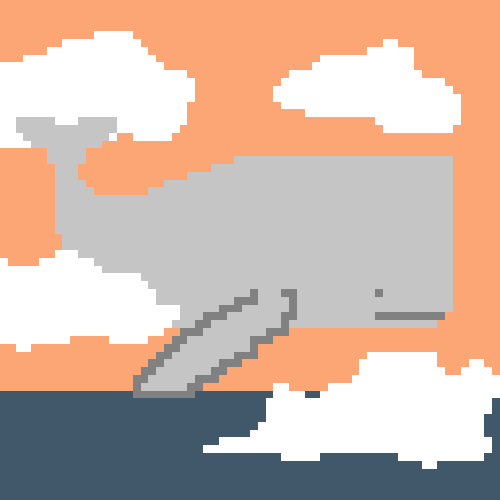
I’d seen pictures and yet I still didn’t really believe they existed. They look more like whales than anything else. A naturalist from The Campus who’d been unfortunate enough to find himself in the canteen at The Stack had told me everything he knew, and everything he’d guessed about the creatures.
Their immense bodies are filled mostly with air. Their metabolism is geared around heating that air as much as possible to keep them afloat. Occasionally assisting themselves with swoops of their great fins and passing over thermal updrafts. They’re social, intelligent, creatures. Floating in large groups like fleets of organic zeppelins. They feed on tiny insectoids that are small, and stupid enough to travel up and above the lower layers of clouds. Like whales feed off krill. They avoid touching the ground other than when they give birth and when they die. And even then, they’ll opt for a flat mountain top.
It would be rare to see them from anywhere in the valley. Not least because of the constant shroud of wet mist. Despite subsisting off the moisture in clouds, they tend to avoid the heavier, stormier kind. For a creature that’s in essence a meat balloon, strong winds and lightning bolts are probably health and safety risks. But one night, I told myself I almost did.
I was woken by a deep hum, that permeated the walls of the stacks of old cargo containers that we call home. It seemed to come from above. I ran outside, head tilted skywards, and as clear as polite conversation I heard the calls of one of the great beasts. It must have been right above us in the lower layers of cloud. The rain was heavy. I was soaked to the bone and it stung my eyes, but my gaze stayed fixed on the sky. It was likely my imagination, but I could’ve sworn for a second, I could make out its form. I was transfixed and smiling maniacally.
Maybe it had gotten lost, maybe it was curious. For whatever reason, that one night I came so close to unimaginable majesty. It gave me hope. And a reason to carry on. The endless monotony. The transition of living in a world with instantaneous communication to a place where messages home are sent and received on a scale of weeks. The long, monotonous days of unfulfilling work. The sleepless, lonely nights in a metal box. They now had purpose.
I just had to bide my time, for a crack in the clouds. Where I’d peak through and one day see pods of these fantastical creatures roaming the skies. A site worth the voyage. On quiet nights when the rain is soft and coincides with rare instances of when machines are powered down, I hear the distant whirrs from far away and remember that there is something worth waiting for.


Loved the world creation here. Fantastic writing.
LikeLike
Thank you! The feedback means a lot. I’ve had the setting in my head for a while but thus far hadn’t managed to build any narratives in it.
LikeLiked by 1 person